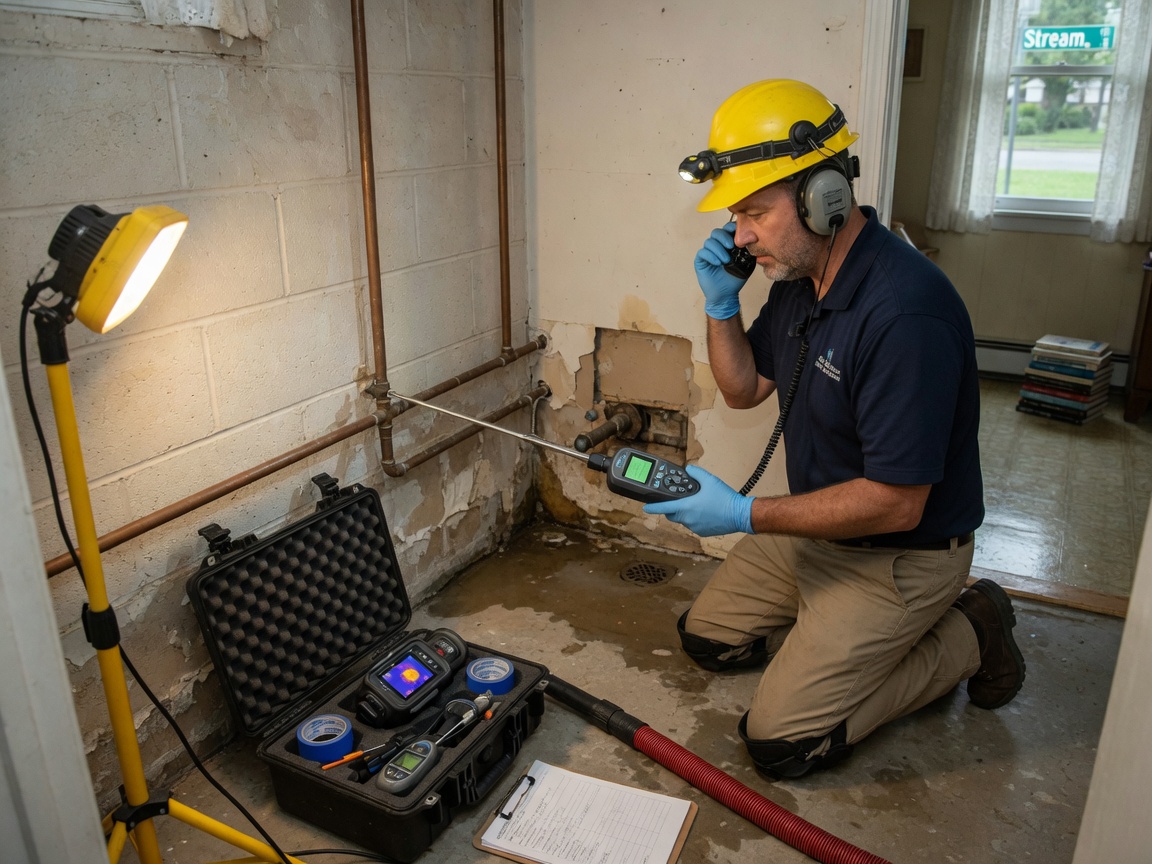
Valley Stream homes built from the 1950s through the 1980s often have copper or galvanized supply lines under concrete slabs that corrode from seasonal humidity swings and occasional freeze-thaw cycles. Detection starts with acoustic listening devices placed at multiple points around the perimeter because the clay-heavy soil common near Valley Stream State Park absorbs sound and can hide small leaks until water reaches the foundation edge. Technicians also check for pressure drops after isolating zones, noting that older valves in North Valley Stream properties frequently leak internally and mimic a slab issue.
Thermal imaging helps locate temperature anomalies along suspected pipe routes under Green Acres Mall-area homes where slab-on-grade construction leaves little crawlspace access. Moisture meters confirm readings at baseboards and in adjacent drywall because humid subtropical summers accelerate mold growth once water escapes the slab. In Elmont and Lynbrook border homes, technicians avoid excavation until the exact joint or fitting is pinpointed to prevent unnecessary concrete cuts near utility easements.
Pressure testing follows manufacturer guidelines for the existing pipe material and accounts for the four-season temperature swings that cause expansion and contraction in exposed sections near Valley Stream Village Hall. When leaks are confirmed, the crew marks the surface with chalk and documents the location relative to landmarks like driveways or sidewalks so the repair team can return with minimal disruption.
Technician insight
In Valley Stream the thing that catches most people out with Hidden Water Leak Detection is the clay soil around 1960s homes near Valley Stream State Park that holds moisture and masks the sound of small leaks until water reaches the foundation edge.
Green Acres Slab Leak Found Behind Driveway
Homeowner noticed rising water bill and damp carpet near the garage. Acoustic listening and thermal imaging traced the leak to a corroded copper joint under the slab two feet inside the driveway edge. We marked the spot, isolated the line, and handed off to the repair crew for a targeted concrete cut with no damage to the rest of the floor.
Hidden Water Leak Detection Services We Offer
✓Acoustic Leak Listening
Uses ground microphones to pinpoint leak sounds through concrete and soil without excavation in Valley Stream slabs.
✓Thermal Imaging Scans
Detects temperature differences along buried lines in North Valley Stream homes where visual access is limited.
✓Pressure Testing and Isolation
Isolates sections of supply lines to confirm hidden slab leaks while protecting older valves common in Green Acres properties.
✓Video Camera Pipe Inspection
Inserts waterproof cameras into accessible lines to locate corrosion or joint failures under Nassau County slabs.
✓Moisture Mapping
Records moisture levels across floors and walls to trace water migration from slab leaks in humid Valley Stream summers.
Hidden Water Leak Detection Cost in Valley Stream, NY
| Service | Typical Range | What Affects It |
|---|---|---|
| Basic Acoustic Detection | $250–$400 | Single-zone listen on accessible slabs |
| Full Thermal And Pressure Scan | $450–$650 | Multiple zones plus imaging in older homes |
| Video Camera Add-On | $150–$300 | When lines are accessible from fixtures |
Ranges are typical for Valley Stream, NY and confirmed with an exact written quote before any work starts.
How it works
- 1
Initial Assessment
Review water bill history and visible signs at the property in Valley Stream or North Valley Stream.
- 2
Non-Invasive Detection
Apply acoustic, thermal, and pressure methods to locate the leak without breaking concrete.
- 3
Confirmation And Marking
Verify the spot with multiple tools and mark the surface relative to driveways or sidewalks.
- 4
Report And Repair Planning
Provide findings and coordinate with the slab repair crew for minimal disruption.
Pricing
Most hidden leak detections in Valley Stream fall between $250 and $750 depending on access difficulty and number of tools required.